Go Links
Go links are your company's shared memory
The Taktoria team6 min read
Ask where the roadmap is and you will get three answers: a link somebody pasted in March, a link to the folder the roadmap used to live in, and "I'll find it." The roadmap exists. The company has simply never agreed on where.
Go links are the smallest fix we know for that: a short name, go/roadmap, that everyone can guess and that always points at the current thing. It is a practice we used at Google and missed everywhere that did not have it. This is why it works, and what keeps it working.
Where a company keeps what it knows
Every company has a memory, and most of it is in the wrong place. It lives in bookmarks, which nobody else can see; in chat history, which scrolls; and in the heads of the few people who have been around long enough to know where things are. Ask one of them and they will find it for you, which works until they are on holiday, or have left.
The cost never shows up as a line item. It is the minute spent hunting for the expenses form, the new hire asking the question four people asked before them, the incident that took longer because the runbook was two clicks deeper than anybody remembered. Each one is small. There are a great many of them.
The deeper problem is staleness. A pasted link is a snapshot: it points at where the thing was when somebody copied it. Documents move, get rewritten, get replaced by a new version at a new address, and the old link goes on circulating with nothing to say it is out of date. A company that shares knowledge by pasting addresses is, quietly, sharing last quarter's knowledge.
A name, not an address
A go link separates the name of a thing from where it lives. go/roadmap is the name; the destination is whichever document holds the roadmap this quarter. When the roadmap moves, somebody changes one link, and every slide, doc, poster and chat message that says go/roadmap is right again.
That is a convention more than a tool, and the convention is the valuable part. Once a company has go links, people stop asking for the link and start guessing it, and they are usually right: go/oncall, go/expenses, go/benefits, go/incident. A new hire can find their way around by typing the obvious name.
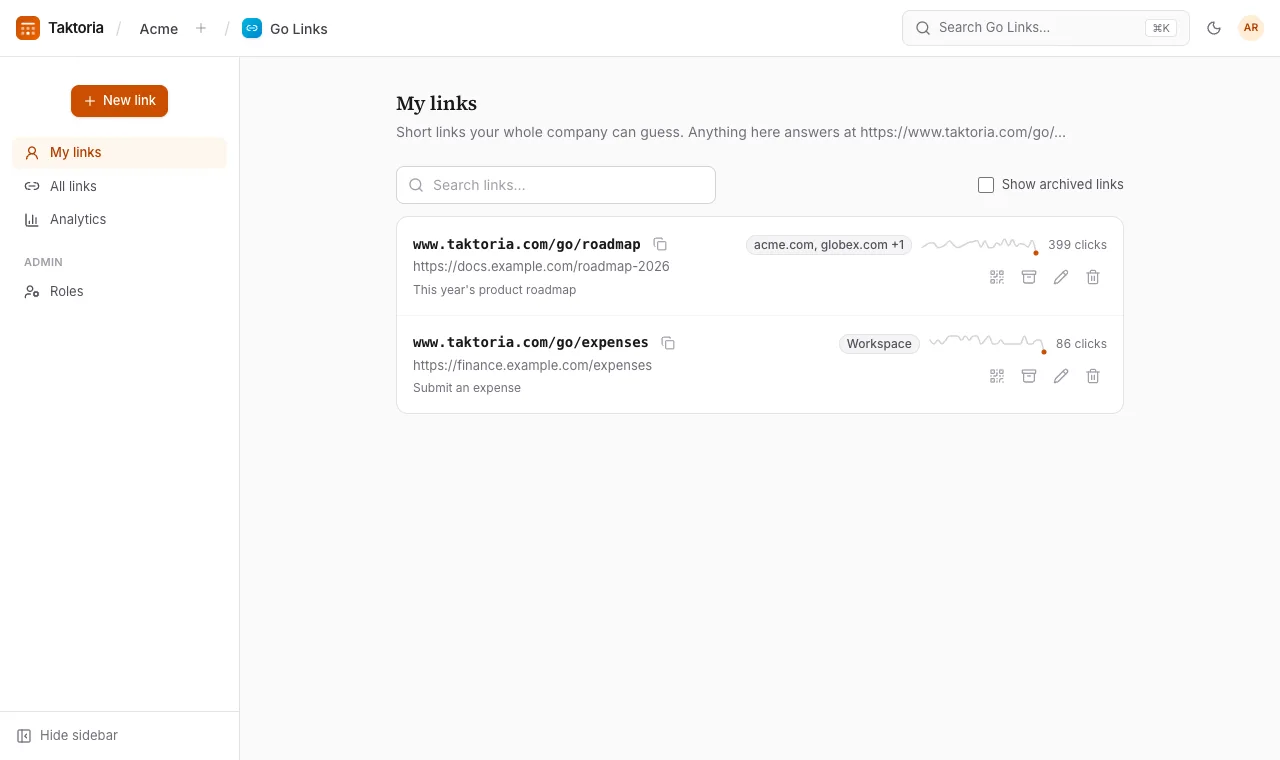
Three small details make the convention reinforce itself. Following a name that does not exist yet opens Go Links with the name filled in, ready to claim, so a wrong guess becomes a new link instead of a dead end. A name can be held as a draft before the thing it will point at is ready: it is taken, but it sends nobody anywhere until it is published. And a link's QR code holds the short name rather than the destination, so a printed poster survives the document moving too.
Name things so they can be guessed
The whole value of a go link is that somebody who has never seen it can guess it. That makes naming the one real skill involved, and a few rules cover most of it.
- Use the word people say out loud. If the team calls it the launch checklist, the link is go/launch-checklist, not go/gtm-readiness-v2.
- Name the thing, not the version. go/roadmap should always mean the current roadmap. If an old one still matters, give it its own name, such as go/roadmap-2025, and let the plain name move forward.
- Prefer plain to clever. A pun is memorable mainly to the person who made it.
- Give a team's own things a prefix. Nested names such as go/design/brand keep a team's links together without taking a plain name the rest of the company may need.
- Write one line on what it is for. The description is what people search when they cannot guess the name, and what tells the next person whether the link still matters.
In Taktoria, short names are lowercase letters, numbers and hyphens, spaces turn into hyphens, and a name is unique within the workspace. The first person to claim one has it.
Every link belongs to somebody
Shared memory needs maintenance, and maintenance needs a name attached. A go link records who created it, and by default anybody with a seat can change it, the way a team wiki works. That default is deliberate: most links are low stakes, and the person who notices one has gone stale should be able to fix it on the spot.
Some links are not low stakes. go/payroll, or a link printed on a thousand conference badges, should not be repointed by whoever happens to be passing. For those, a link can name the people who may change it, and then only they, its creator and the workspace's admins can. A lock icon marks it in the list.
What we would not allow is a second team quietly overwriting a name the company relies on. First claim wins, and the second team talks to a person. Every change lands in the workspace's audit log with who made it and what changed, so "who pointed go/roadmap at the draft?" has an answer. And a link keeps working when the person who made it leaves; an admin can name somebody still there to look after it.
Who may follow a link
A go link is an ordinary web address, so it works off the office network, on a phone, in a hotel. That raises a question an intranet never had to answer: who may follow it?
Our answer is that the link decides, because the person who made it knows what it points at. On the workspace's own hostname, such as go.acme.com, each link chooses one of three audiences:
- People at certain email domains, the default. Somebody following the link proves an address at one of its domains, with Google or a code we email them, and goes straight on. No account is made, and the proof lasts 30 days in that browser.
- Members of this workspace, signed in.
- Anyone with the link. Nothing is asked, and the form warns you so. Right for a page anybody may read.
The domains come from one list the workspace keeps in Settings → Domains: its verified domains and its partners'. A link takes the whole list or a few from it, and a domain taken off the list stops counting on every link at once, so nobody has to comb through hundreds of links when a partnership ends. The same list decides who can join a Dory event kept to certain email domains, which matters for the kind of town hall we wrote about in The question nobody asks out loud.
One rule we hold firmly: until somebody has proved who they are, a link that is not open to them looks exactly like a link that does not exist. Otherwise anybody could learn which links a company has, and so a fair amount about the company, by guessing names. On Taktoria's own address, go links always need a signed-in member.
Links rot, so look at them
Every link is a small promise that the thing is where the name says. Promises go stale. The document is archived, the team renames its process, the tool is replaced, and go/onboarding now points at last year's checklist with nothing to say so.
The fix is mostly to look. Every link shows how many times it has been followed and a line of its last 30 days, and the list is sorted by use, so the links people rely on rise to the top and the dead ones sink. A link nobody has followed in months is usually pointing at something that moved, or at something nobody needs.
A few habits keep a set of go links healthy:
- Fix the link, not the message. When somebody posts a stale address, repoint the go link and reply with its name.
- Archive rather than delete. An archived link leaves the list and keeps working, so the old deck that still says go/q3-plan does not break. Delete only what should stop working.
- Rename sparingly. Renaming a link frees the old name, and the old name stops working. If a name was wrong, it is often kinder to create the right one and leave the old one pointing at the same place.
- Tidy once a quarter. Look at the bottom of the list, and ask whoever made each link there whether it still matters.
None of this needs Taktoria; a spreadsheet of redirects follows the same rules. If you would rather have the names, owners, audiences and click counts in one place, Go Links does that, and its help article covers setting up your own hostname.
go/anything, and everyone knows where it points.
See Go Links