OKR Hub
Objectives and key results that stay honest.
$3 per user / month
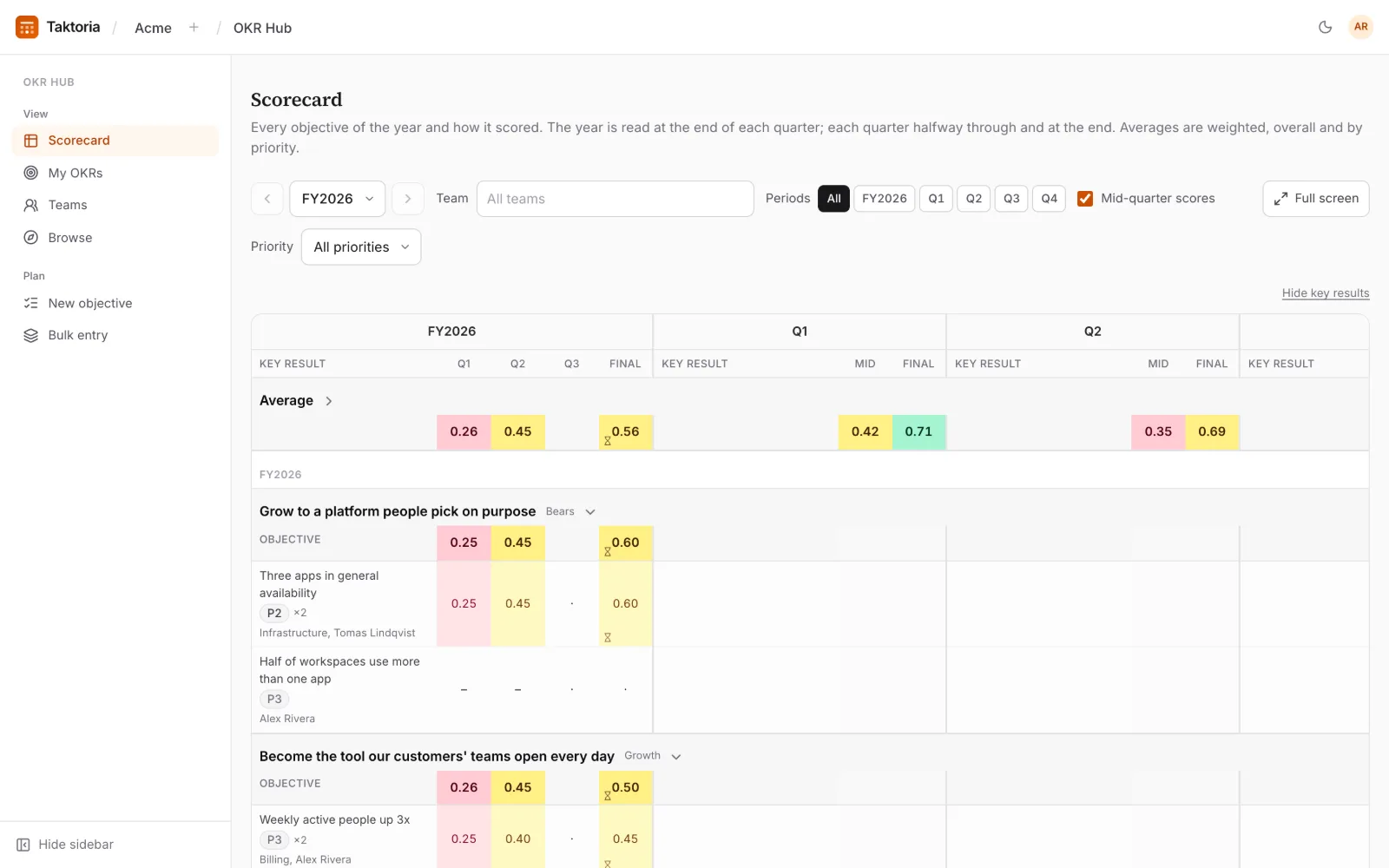
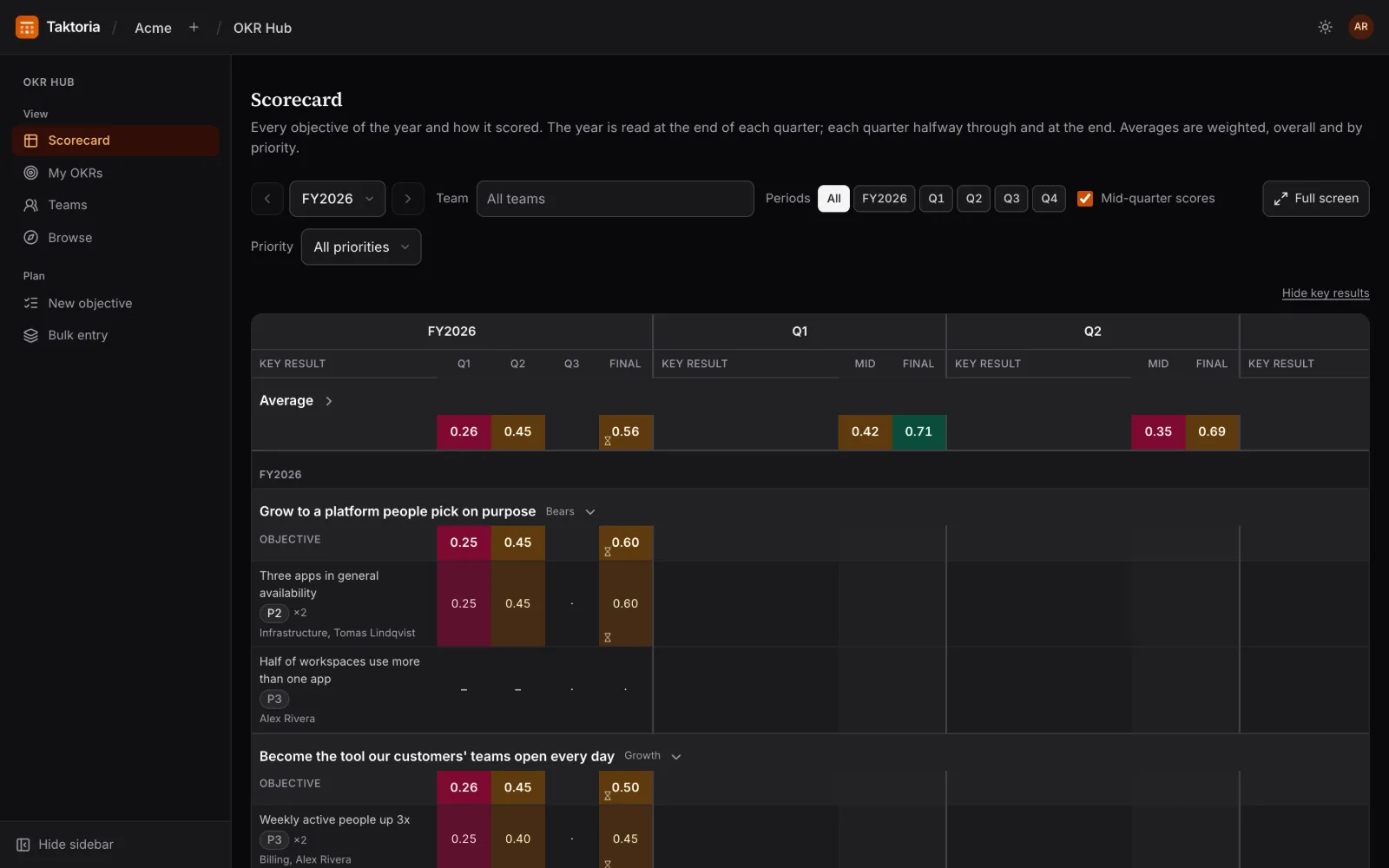
Share key results out to people and teams, check in as they move, and grade the whole year on one scorecard.
Why it exists
Objectives are usually written with real care in the first week of the quarter and then not opened again until somebody has to report on them. By then the number is whatever it is, the story is written backwards to fit it, and the goal that was supposed to steer the quarter turns out to have described it instead.
OKR Hub is built around the check-in rather than the document. Each key result has its own owners, people or teams, who record a grade from 0.0 to 1.0 and a note on why it moved, as it moves. Objectives, teams and the whole workspace roll up from those grades, weighted, overall and by priority, and every score carries its line through the quarter, so the story is written while it happens rather than backwards at the end.
Inspired by the way this was run at Google: the parts that earned their keep, without the parts that only work at that scale.
What you get
- Key results with their own owners, weights and priorities
- Check-ins with a note, graded 0.0 to 1.0
- A year-long scorecard with comments and history
How it works
- 1Set objectives and share out the key resultsAn objective is the sentence people repeat, owned by a person or a team. Each key result under it has its own owners, weight and priority, so the work sits with whoever is actually doing it.
- 2Check in as it movesOwners record the grade and a note on why it moved, dated when it stood there, even if they write it up after the meeting. It takes a minute and it is the entire mechanism.
- 3Grade the year on one scorecardEvery objective of the year on one screen, read at the middle and end of each quarter. Set a grade in the meeting, write down why beside it, and see who changed what. Filter by team, priority or quarter, and put it up full screen.
What teams use it for
Running a quarterly business review
The history is already there: what was committed, what each check-in said and when, and the line each score took through the quarter. Nobody has to reconstruct it from memory.
Grading the quarter in one meeting
Put the scorecard up full screen and grade each key result together. The comment beside a grade, and the record of who set it, are still there when somebody asks next quarter.
Seeing which teams are carrying the goal
The teams page shows every team's score for the period, and can sort by it. A key result held by several teams counts for each of them, so shared work shows up where it was done.
Common questions
- Is this OKRs specifically, or any goal framework?
- The model is objectives with measurable key results underneath, which is what OKRs are. If you call them something else but work the same way, it will fit.
- What if a key result is not a number?
- Then it is probably an objective or a task. Key results are graded 0.0 to 1.0: 0.7 and up is a success for an ambitious goal, 0.4 to 0.7 is progress, and below that little moved. A grade, not just a report, is what makes one quarter comparable with the next.
- Does everyone need a seat?
- Everyone who uses OKR Hub does, whether they own key results, check in or read the scorecard. Seats are per person, per app, so people who never open it are not billed for it.
- Who can change what?
- An objective's owner, its team and admins can edit it and its key results. A key result's own owners, directly or through a team, can check in, grade it and comment on it, without being able to change the objective. An objective with no owner can be edited by whoever created it and by admins.
The rest of the platform
One workspace, one bill, one set of members. Add an app whenever you need it.