Dory
The question nobody asks out loud
Het Taktoria-team6 min lezen
Dit bericht is in het Engels geschreven.
Every all-hands has a question that half the room is thinking and nobody asks. It goes unasked because asking costs something, and the cost falls on one person while the answer would have gone to everyone.
We think that is a design problem rather than a courage problem, and design problems can be fixed. This is how we think about questions at all-hands meetings, town halls and conferences, and why Dory works the way it does.
Asking out loud is a career calculation
Picture the end of a company meeting. The presenter says there are ten minutes for questions. There is a pause long enough to be uncomfortable, then somebody senior asks something safe, or a regular asks the question they always ask. The meeting ends on time. The presenter thinks it went well.
Meanwhile the question people actually had, about the reorganization, the missed target or the policy that changed without explanation, leaves the room with them. It gets asked afterwards in a private chat, where it is answered by guesswork.
Nobody in this picture is behaving badly. Standing up in front of the whole company to ask why a decision was made is a calculation, not a curiosity: it puts your name to a doubt, in front of the people who will write your next review. Most people run that calculation and stay quiet. The ones who do not are the most senior, the most confident or the least worried, which is a small and unrepresentative sample of the room.
An open microphone looks neutral. It is not. It quietly selects for who feels safe, and the questions it surfaces are theirs.
Why the usual fixes fail
Most companies notice the silence and try something. The common fixes each solve part of the problem and break something else.
- Send questions to an inbox beforehand. Somebody reads them, picks a few and paraphrases them. Nobody can see what anyone else asked, so nobody can tell whether the hard question was skipped. People learn quickly that it might have been.
- Ask in the chat channel. Better, because the room can see the questions. But every one carries a name, the order is whoever typed first, and the thread scrolls away while the meeting goes on.
- Collect them in a shared document. Visible, but there is no way to say "me too" short of writing the question again, and the list is ordered by when people arrived.
- Have the host choose. This makes the host both the bottleneck and the filter, and the room knows it.
The pattern is the same each time. The fix lowers the cost of asking for some people, while leaving the order, and the filter, in the hands of whoever runs the meeting. A Q&A works when the room can see what the room wants.
What we hold to
Dory is named after the Q&A tool Google uses at its all-hands meetings and events, and the habit behind it is one we saw work there: people ask a question or share an idea, the room upvotes, and the speakers answer what most people want answered. Taktoria is not affiliated with Google, and our Dory is built for any company. The principles are short.
Asking should cost nothing. An attendee joins with a six-character code, or by scanning the QR code on the slide. No account, no download. Every step in front of the question box is a step where the quiet half of the room drops out.
Anonymity has to be real. Anyone can ask anonymously, unless the host has turned it off for that event. The host sees the question, not the asker, and the export says Anonymous. An audience that suspects anonymity is a figure of speech goes quiet, and a quiet audience is the thing this exists to fix.
The room sets the order. Everyone gets one upvote per question, and the list is sorted by them, most wanted first. When somebody asks what has already been asked in slightly different words, Dory adds their upvote to the existing question instead of listing a near-copy, so support collects in one place rather than spreading across five versions of the same thing.
Moderation is for the line, not for the uncomfortable. A host can choose to approve questions before the room sees them, and can dismiss one at any point. That is for abuse, spam and the occasional thing that belongs with HR rather than on a projector. It is not for the hard question. If the top-voted question vanishes, the room notices, and it will not trust the next meeting's Q&A either. The profanity filter, on by default, masks rude words with asterisks rather than throwing the question away.
Before, during and after
A live Q&A is the middle of something, not the whole of it.
Before. An event can start taking questions before the meeting does. A town hall that opens questions a few days ahead gets the considered ones, the ones people needed time to phrase, and the presenter sees what is coming instead of meeting it on stage. It is also the fair way to include people in time zones where the meeting falls at an awkward hour.
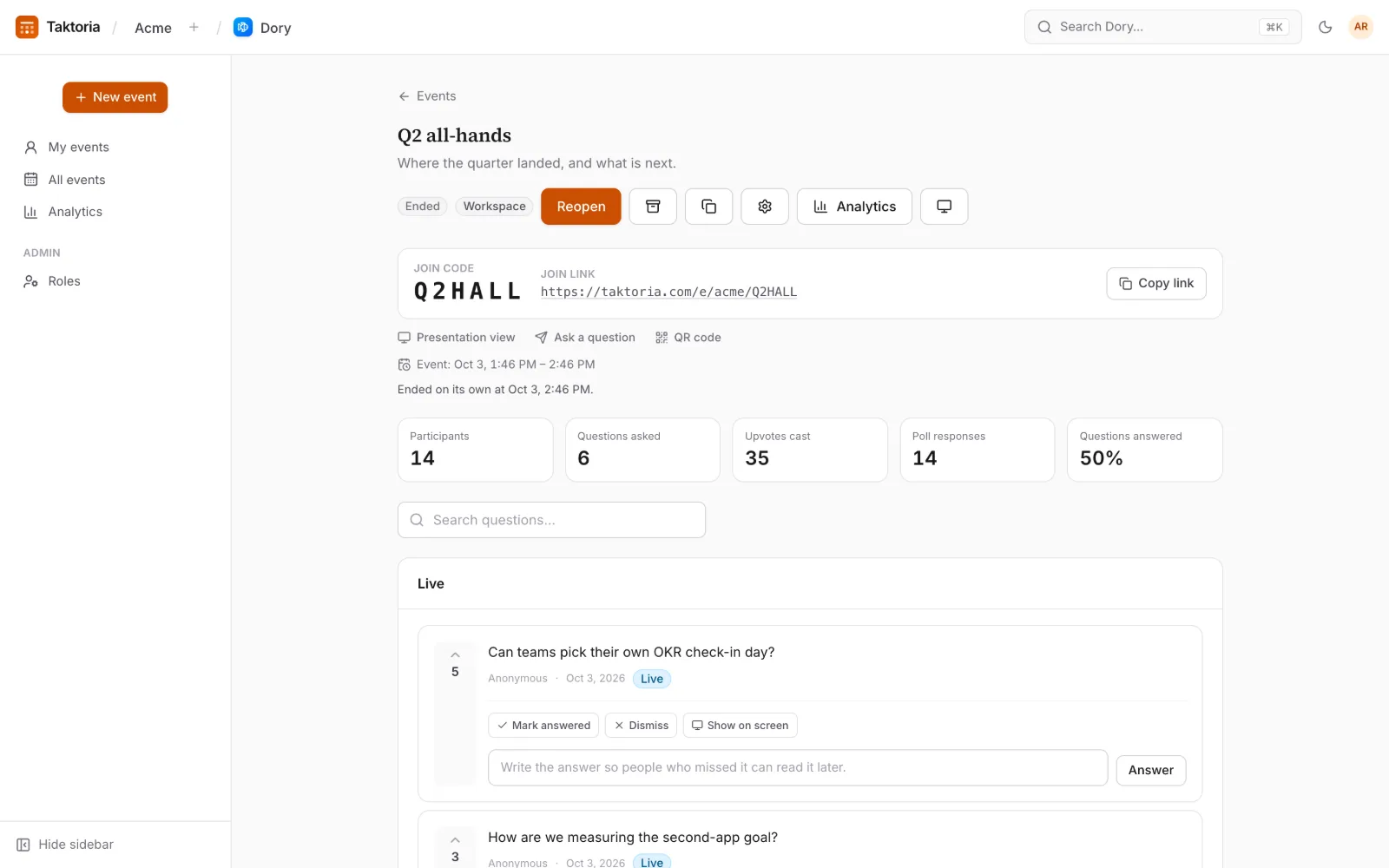
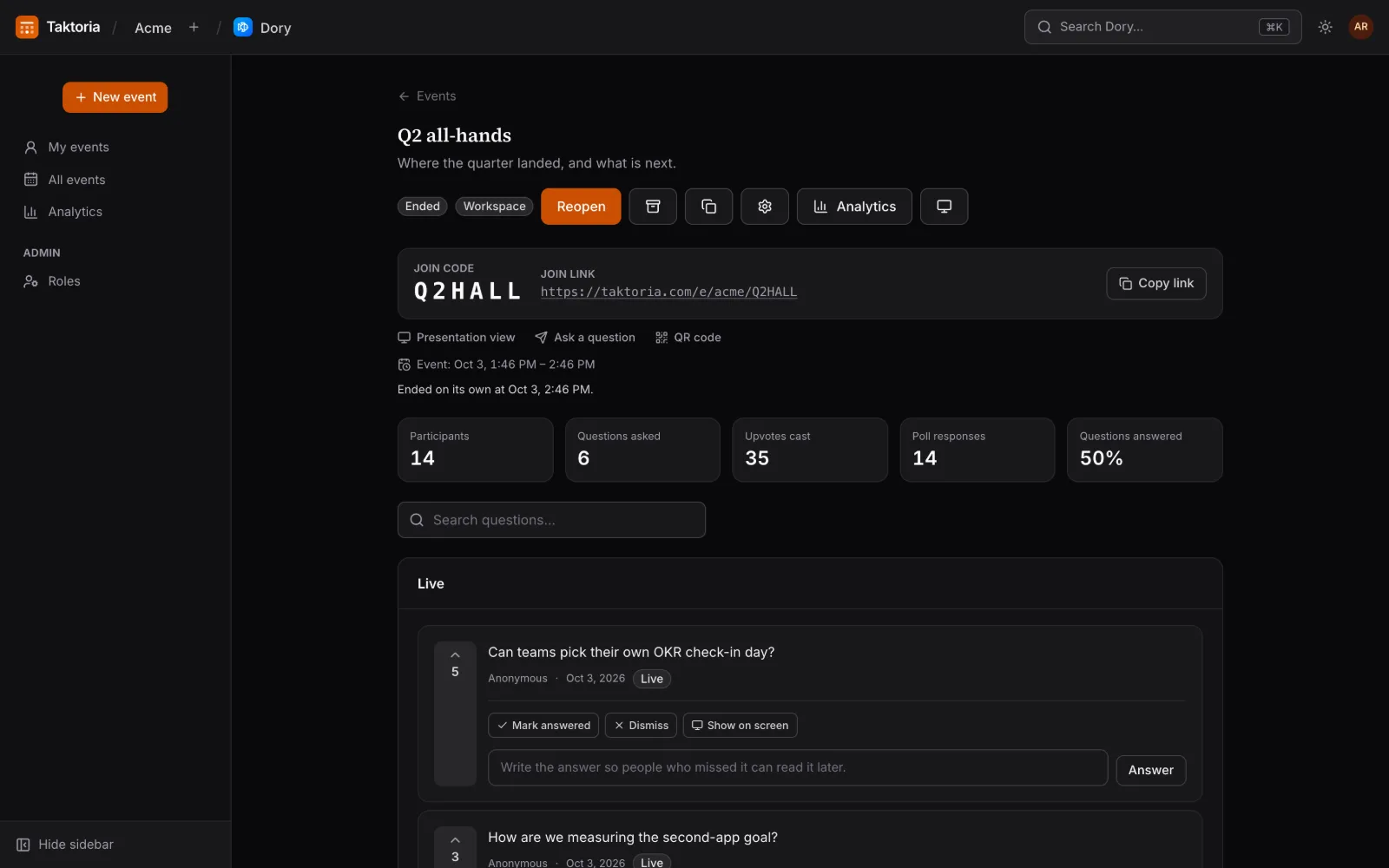
During. The presenter screen is built to be read from the back row: how to join, the question on screen and what is waiting. A host can put up one question at a time, or work the queue from the big screen itself, most upvoted first, marking each answered or skipping it. Polls, word clouds, rankings and quizzes, with a leaderboard that rewards speed, break up a long session and tell the speaker things about the room it would never have said out loud.
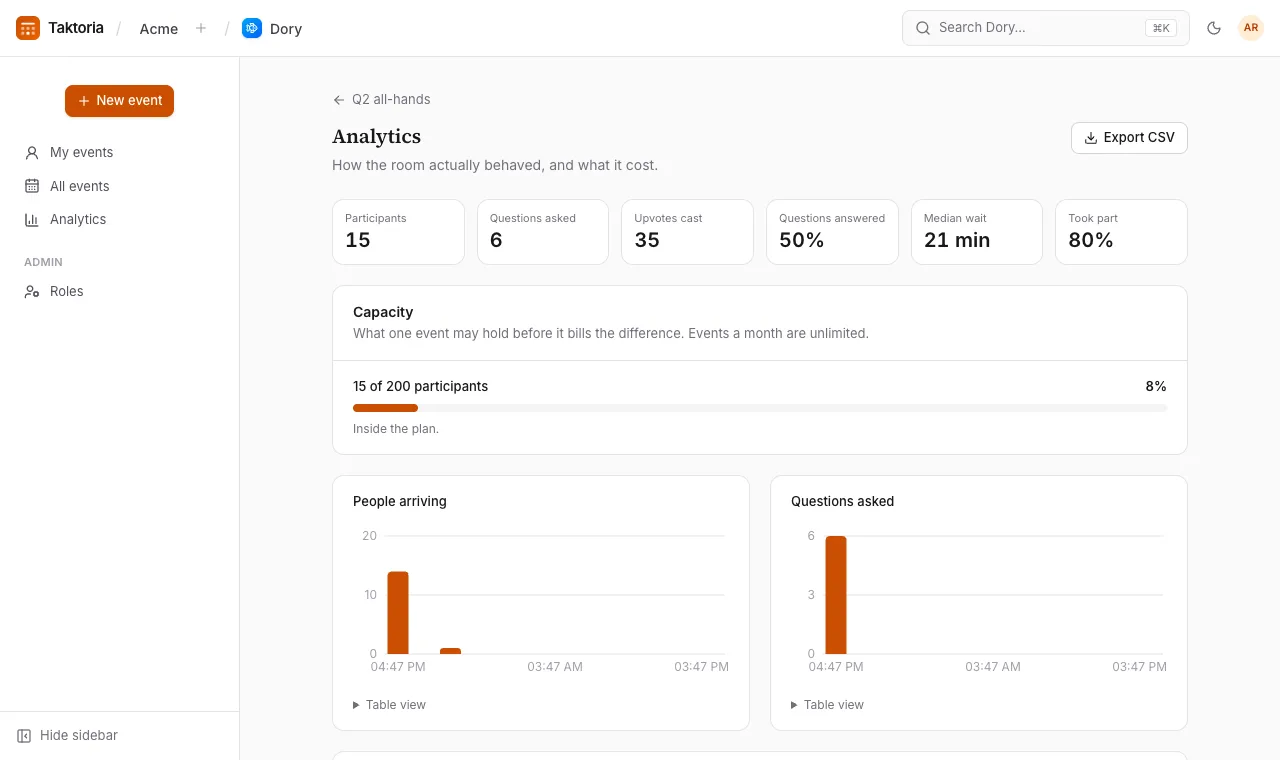
After. This is the part most Q&A tools forget. Every meeting runs out of time with questions still on the list, and those are often the useful ones, because they are what people still want to know. A host can write an answer to any question, so people who missed the meeting, or who were there and ran out of time, can read it later. The event's analytics show how many people took part, how many questions were answered and how long the median question waited, and every question exports as a CSV with its upvotes and its answer.
How to run a better Q&A, with or without us
Most of what makes a Q&A work is how the people running it behave. Some of what we have learned, which holds whatever tool you use:
- Start with the top question. Whatever it is. Answering the most-voted question first tells the room the ranking is real. Skipping it for an easier one tells them the opposite, and they will remember.
- Open questions early. A few days before an all-hands is enough. The questions get better, and the answers can be true rather than improvised.
- Say what you cannot answer, and why. "We can't discuss that until the deal closes" is an answer. Silence, or a change of subject, is read as something worse.
- Keep moderation narrow, and say what it covers. Tell people what gets hidden, such as abuse or attacks on a named colleague, and hide nothing else.
- Write down the ones you did not reach. The questions left when time ran out are a to-do list. Answer them in writing within the week, where everyone can read them.
- Look at the numbers afterwards. If many people joined and few asked, asking still costs too much. If many asked and few were answered, the session was too short or the answers too long.
At a conference the same rules hold, with one more: read the question out before answering it, because part of the audience cannot see the screen and the recording cannot see it at all.
Dory is part of Taktoria. See how it works, or read the help article to set up a first event.
Stel een vraag of deel een idee. In gesprek met sprekers en de hele zaal.
Bekijk Dory