Memegen
Memes are how internal news actually travels
Taktoria 팀6분 분량
이 글은 영어로 작성되었습니다.
The migration finished on Tuesday. The announcement email went to everyone, collected a polite handful of reactions and was read mostly by the people who already knew. The meme somebody made about it an hour later had been round the whole company by lunch.
That is not a failure of the email. It is how news travels inside a company, and we think it deserves to be taken seriously rather than tolerated.
The email nobody read
Internal communication is mostly written as if attention were free. The update goes out, the wiki page is published, and everyone involved is surprised when, three weeks later, half the company has not heard.
A meme travels because it does three things an announcement rarely does. It is short enough to take in during the second before you scroll past. It carries a feeling as well as a fact: not just that the on-call rotation changed, but how the people on it feel about the change. And people pass it on themselves, because sharing a good one is a small social act rather than a chore.
That last part matters most. Nobody forwards a policy update to a friend on another team. They do forward the picture that made them laugh, and the news comes along with it. A company that wants its news to reach people could do worse than notice which format people actually pass on.
Culture is a channel
It is tempting to treat memes as decoration on top of the real communication. We think that has it backwards. A company's running jokes are shared context: the format everybody reaches for when a launch slips, the template that means "this meeting could have been a doc". A new hire who understands them has understood something true about how the place works.
That makes them one of the more honest signals a leadership team gets, too. The meme feed says what people find absurd, frustrating or worth celebrating, in their own words, with their names on it. It is not a survey, and it is better read than measured, but anybody who reads it for a week learns things the engagement survey did not tell them.
An internal meme generator is one of the practices we used at Google that Taktoria is built from, and this is the reason it made the list. If culture is a channel, it deserves what any channel needs: somewhere it lives, a way to find old messages, and some care about what goes into it.
The template library is the culture
What makes an internal meme generator different from a public one is its template library. A public site has the well-known formats. A company's library has those and its own: the photo from the offsite, the whiteboard nobody erased, the expression somebody made during a demo that went sideways. Those are the templates that only make sense inside, and they are the ones that get the laugh.
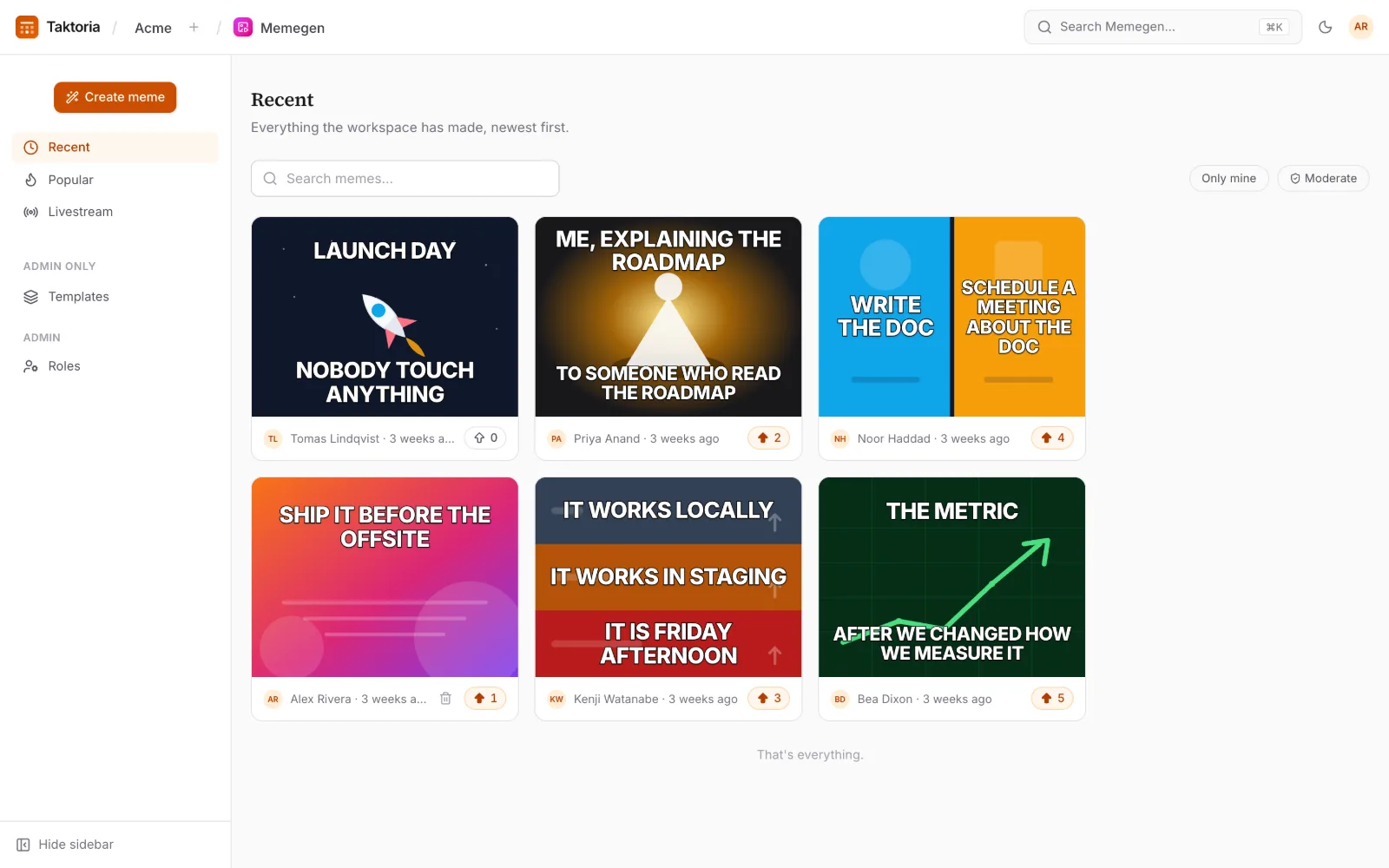
So we built Memegen around a library the workspace curates. Its admins add templates, from an upload or an image address, arrange them in the picker, and take out the ones that have run their course. When the library lacks a format, anybody can search hundreds of well-known ones in a database of meme formats, or upload a picture of their own. A background found or uploaded that way is used for that one meme only; it does not join the shared library unless an admin adds it. That keeps the picker a reflection of the company's taste, rather than of everything anybody ever tried once.
Taking a template out never breaks what was made from it. A removed template leaves the picker, every meme made from it keeps rendering, and only an admin can bring it back.
Moderation is mostly attribution
Every company that considers an internal meme tool asks the same question: what stops it going wrong? Our answer is mostly a design choice rather than a filter.
Every meme carries its author's name. There is no anonymous mode, and that is deliberate. Anonymity is the right default for a question at an all-hands, where the point is to take the cost out of asking; we argued that in The question nobody asks out loud. A meme is the opposite case. It is a joke told in front of colleagues, and a joke with your name on it is one you think about for a second before posting. That second settles most of it.
For the rest, the tools are plain. Anybody can delete their own memes. Memegen's admins can turn on Moderate and delete anybody's. A Viewer of Memegen sees the feed and makes nothing. And a meme's address only opens for people in the workspace with a Memegen seat, so an internal joke stays internal even when its link is pasted somewhere it should not be.
Upvotes do the rest of the curating. Each person has one vote per meme, and Popular shows what people liked over the past hour, day, week, month or all time. Taste is collective, and the feed lets it show.
Making it work, with or without us
An internal meme culture cannot be mandated; a meme that was assigned is not funny. It can be made easy, and it can be given permission. Some things we have seen help:
- Seed the library with in-jokes. Ten templates only your company understands do more than a thousand generic ones. Ask people for the pictures everybody already refers to.
- Make one at the moments that matter. A launch, a migration finished, a quarter closed. A meme that lands while the good feeling is still there is half the celebration.
- Attach one to the announcement. The email still carries the details; the meme gets it opened.
- Let leaders be the subject. A company where the chief executive can be the punchline, kindly, is one where people believe they can speak up.
- Know when not to. Layoffs, bereavements and anything that hurts a named person are not material. Say so once, early, and the norm mostly holds.
- Keep it findable. Being able to search what everybody has made is what lets a running joke outlive the person who started it.
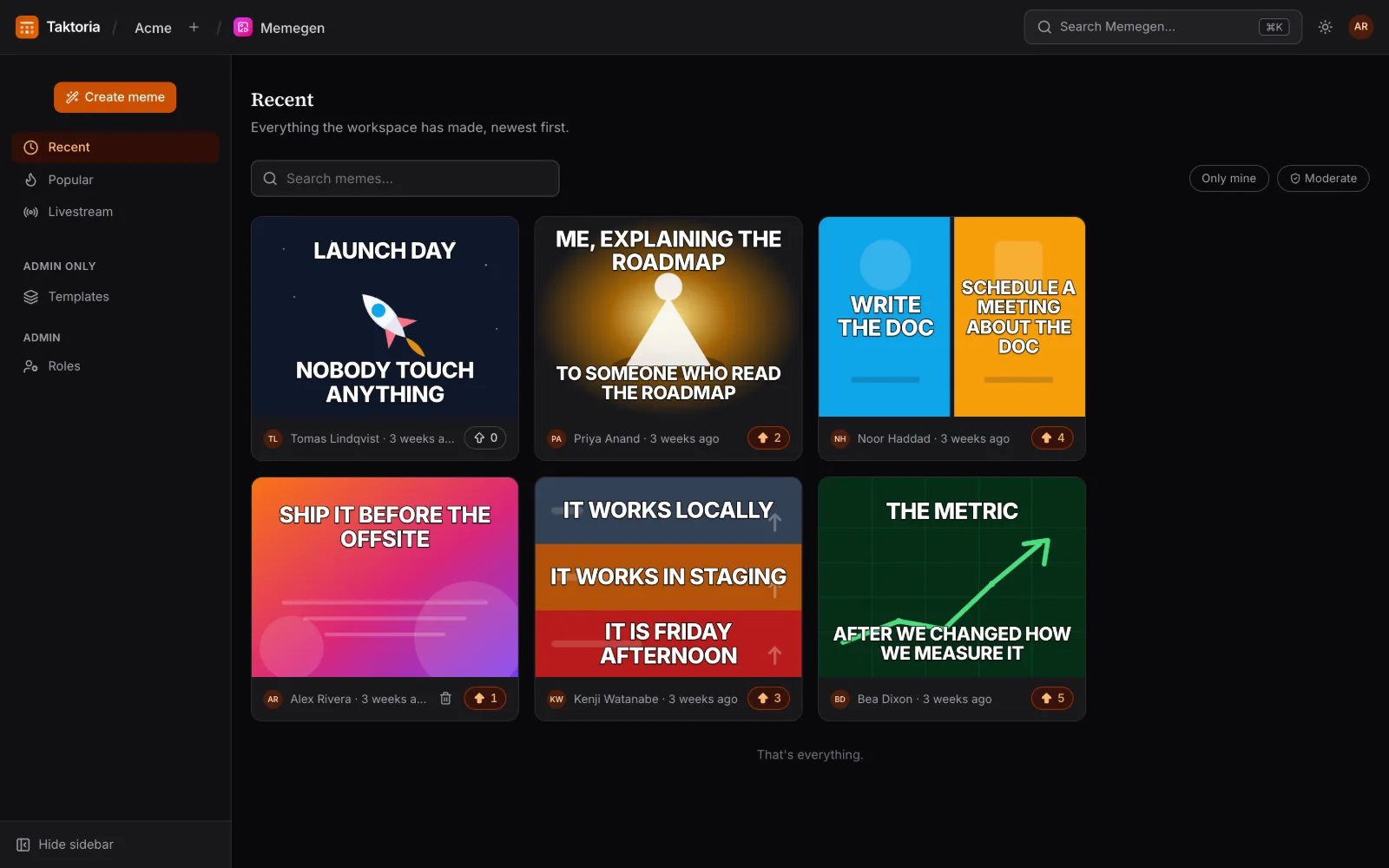
In Taktoria, making one is a thirty-second job: pick a template, add the words, post it, and get a permanent link and a PNG for anywhere else. Livestream keeps the feed refreshing on its own, which makes it a surprisingly good thing to leave up on a screen in the office. Memegen is the place to start, and its help article covers curating the library.
공유 폴더 없는 사내 밈 생성기.
Memegen 보기