OKR Hub
OKRs that stay honest after the first week
Taktoria 팀6분 분량
이 글은 영어로 작성되었습니다.
Objectives and key results are easy to write and hard to keep. The care goes into the first week of the quarter. The grading happens in the last, from memory, and the story is written backwards to fit the number.
We think OKRs stay honest when three things hold: the score comes from the key results and nowhere else, it is recorded as it moves rather than reconstructed at the end, and everybody agrees what a grade means before anybody is graded.
Where OKRs go wrong
The idea is old and simple. Andy Grove ran Intel on objectives with measurable results underneath them, John Doerr carried the practice to Google and wrote it up for everyone else, and a generation of companies adopted it. An objective is what you want, in a sentence. Its key results are the numbers that will tell you whether you got it.
The idea rarely fails. The upkeep does. The familiar ways it goes wrong:
- Written once, read once. Objectives get real attention in week one and are not opened again until somebody has to report on them.
- Scored by feel. The objective gets a colour, usually green, chosen by its owner, unconnected to the key results under it.
- Graded from memory. At the end of the quarter, the number is whatever it is, and the explanation is assembled to suit.
- Ambition by accident. Some goals were stretches and some were promises, nobody wrote down which, and both are graded on the same curve.
The usual fixes treat the symptoms. A spreadsheet holds the latest number but not how it got there, and anyone can overwrite it. A traffic-light status reports mood rather than progress. A quarterly review meeting turns into archaeology: an hour of reconstructing what everyone believed in week six.
The problem is the same one we described in launches: the record lives somewhere other than the work. OKR Hub is built so that it cannot.
The score comes from the key results
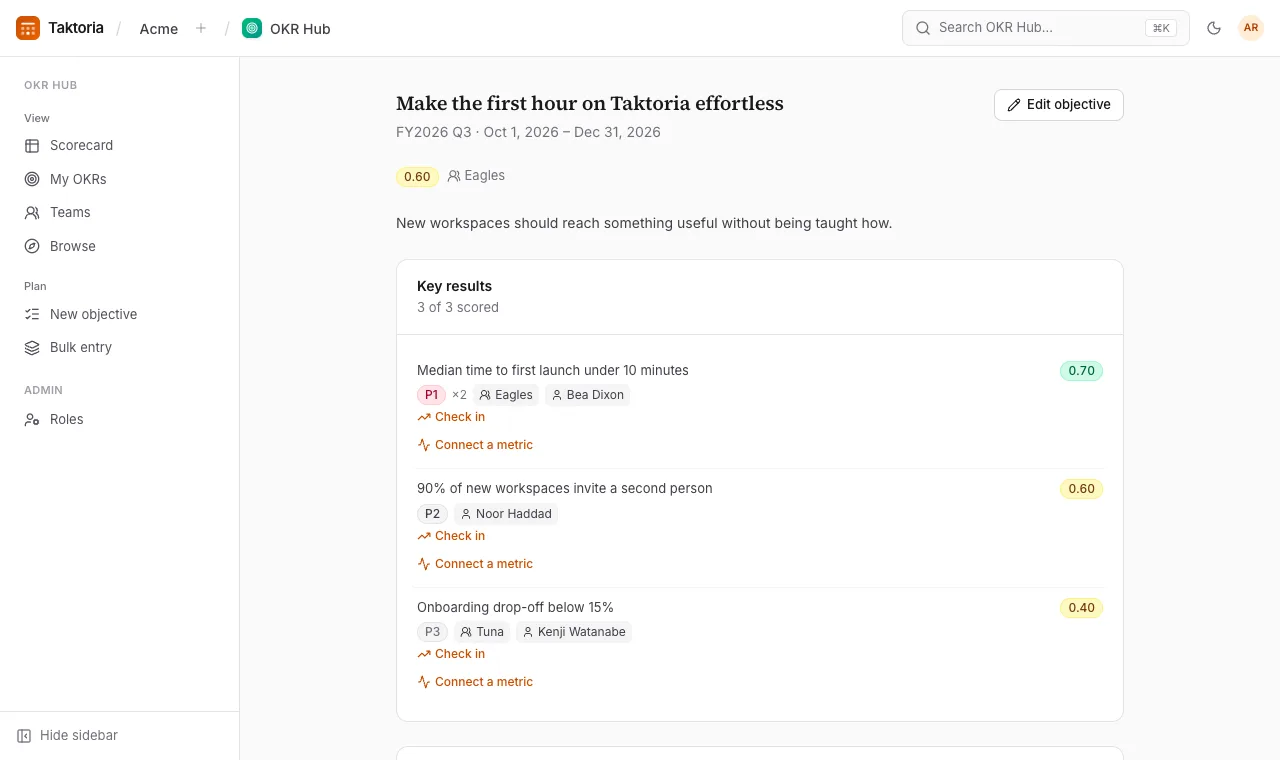
In OKR Hub, nobody types in an objective's score. There is nowhere to type it. An objective's score is its key results' scores averaged by weight, worked out each time it is read.
Three rules make that average honest.
Weights are explicit. Three key results are rarely worth the same. An average that pretends they are will flatter an objective or punish it for no reason, so each key result carries a weight, 1 by default, and the important one can count twice.
Not graded is not zero. A key result nobody has graded yet is left out of the average rather than counted as nothing. Otherwise every quarter would start at zero and crawl, and the early weeks would say more about grading habits than about progress.
Objectives count once each. A team's average, or a quarter's, is its objectives' scores averaged by the objectives' own weights. An objective with ten key results does not outvote one with two.
The effect is that a score can be argued with, because it can be traced. If an objective reads 0.60 and somebody thinks it should be higher, the conversation moves to the key result that is holding it down, which is where it should have been all along.
Check in as it moves
A grade at the end of the quarter tells you where you landed. It does not tell you when things went wrong, or what anyone believed along the way. That is what check-ins are for.
A check-in in OKR Hub is a grade from 0.0 to 1.0 on one key result, with a note on why it moved. It takes a minute. The note is the part worth reading three months later.
Check-ins are never edited. A corrected grade is a new check-in. That can feel fussy, but it is the point: the history shows what was believed when, not a tidied version of it. A quarter that looked fine in week six and fell apart in week ten is a different lesson from one that was never on track, and only an untouched history can tell them apart.
From those check-ins OKR Hub draws a line for each objective and each team across the period. Each point is rebuilt from every key result's latest grade at that moment, so a week in which only one key result moved does not make the whole objective jump to that one number. The scale is always 0 to 1, never fitted to the data, because a grade only means something against the whole range, and a chart that stretches 0.61 to 0.63 into a cliff is lying. A dashed line marks 0.7.
Agree what a grade means
A 0.6 means nothing until a company agrees what it means. OKR Hub uses the scale that has served ambitious goals well:
- 0.7 and up is delivered: a success for an ambitious goal.
- 0.4 to 0.7 is progress: something real moved, short of the target.
- Under 0.4 is missed: little moved.
The scale only works if the goals are ambitious. If every key result lands at 1.0, the targets were set where the team already knew it would end up, and the grades say nothing. If every one lands at 0.2, they were wishes. The useful zone is in between, and a company that consistently scores around 0.7 is probably aiming about right.
Not every goal should be a stretch. Some things are promises: the compliance deadline, the migration that has to finish before the contract ends. The usual distinction is between committed goals, where anything short of 1.0 is a miss, and aspirational ones, where 0.7 is a win. Decide which a key result is when you write it, and say so in its title or description. Deciding at grading time is how a missed commitment gets reported as a respectable stretch.
Then grade the quarter together, in one sitting, with the people who own the work in the room. OKR Hub lets you grade a whole set of key results on one screen, and a key result nobody grades stays ungraded rather than becoming a zero. Grading in a group is slower than grading alone, and much harder to fudge.
Quarters are your own
OKRs run on quarters, and a surprising number of tools assume the quarter starts in January. Plenty of companies do not. If the budget, the board meeting and the sales targets run on a year that starts in April, OKRs that run on the calendar year drift a month or two out of step with everything they are meant to steer.
In OKR Hub, an admin sets the month the workspace's fiscal year starts in, and every quarter follows it. A fiscal year is named after the calendar year it starts in, so with an April start, FY2026 runs from April 2026 to March 2027, and its Q3 is October to December. An objective runs for a quarter or for the whole fiscal year, and annual objectives sit alongside the quarter's.
Each team has a page of its own for the period, with its objectives, its score and the line of how that score moved. Other views organise the quarter by objective. This one organises it by who is accountable, which is how a team actually works through one.
What to do on Monday
Most of this works with a spreadsheet and some discipline. If you change only a few things, change these:
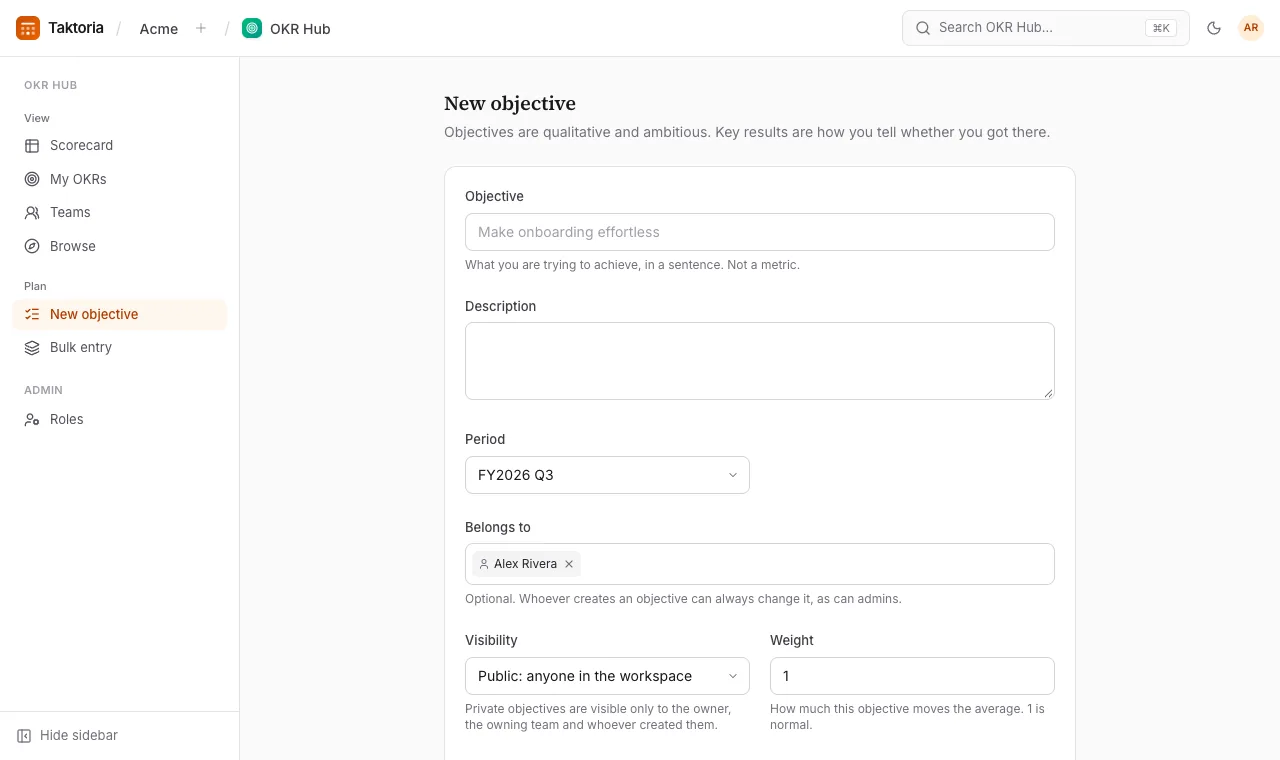
- Write each objective as a sentence and each key result as a number. Three to five key results is plenty.
- Weight what matters. If one key result is the point, let it count for more.
- Never score an objective directly. Let it come from its key results.
- Check in every week or two, with a note, even when nothing moved. "Nothing moved, because legal has the contract" is information.
- Never overwrite a grade. Correct it with a new one, so the history stays true.
- Mark commitments as commitments when you write them, not when you grade them.
- Grade the quarter together, and leave the ungraded ungraded.
The discipline is the hard part, which is why we built OKR Hub to carry it. The help article shows how to write your first quarter.
끝까지 정직하게 유지되는 목표와 핵심 결과.
OKR 허브 보기